Exploring Voice in Writing
Reflections, exercises, and thoughts

Voice is one of the most interesting and challenging aspects of writing, and I’ve been reflecting a lot on it the past week.
It all started with the its being the topic of the week in one of my MA in Creative Writing classes, Writing the Short Story. According to the American novelist and screenwriter Raymond Chandler said: “The most durable thing in writing is style, and style is the single most valuable investment a writer can make with his time.”
To get you thinking about voice, here are the components of voice as discussed by Ailsa Cox in Writing Short Stories.
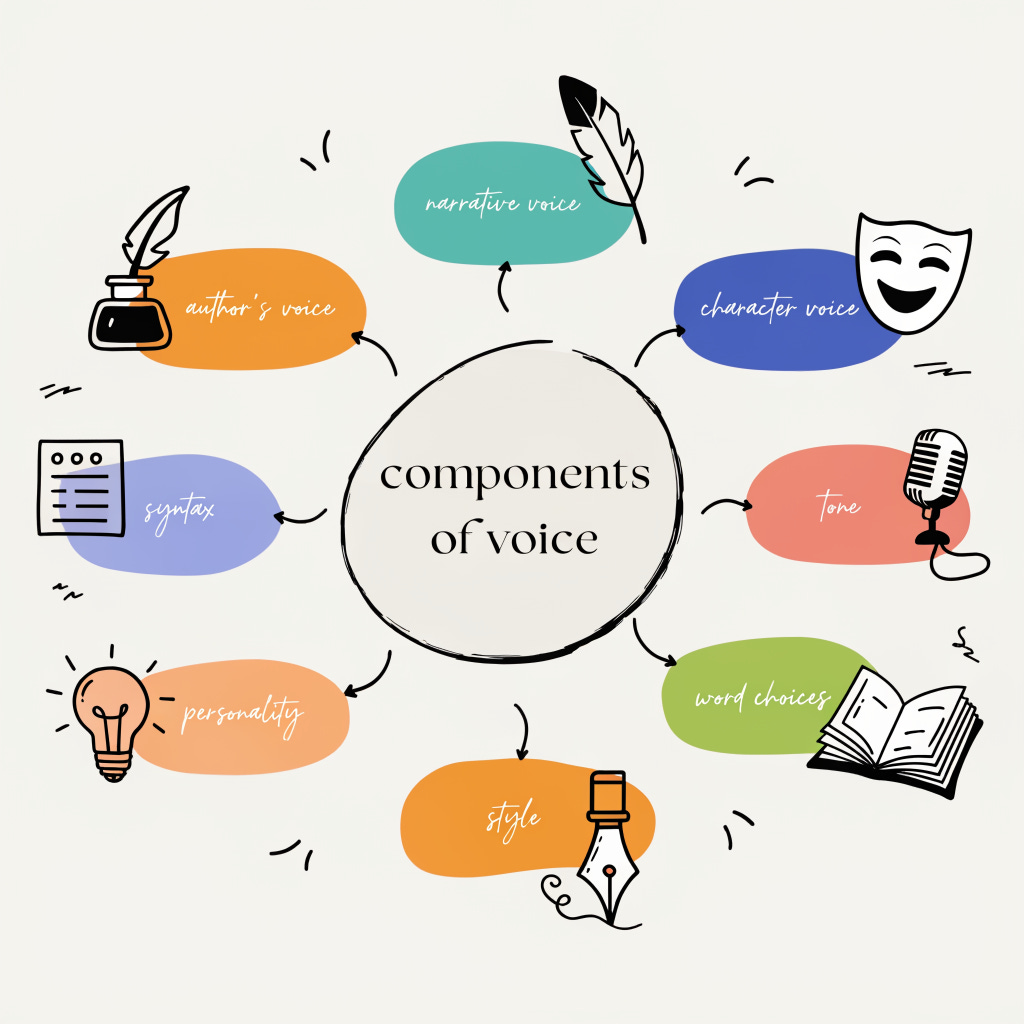
Because that was the topic for the week, and all the assignments were going to be around it, I started thinking about it more and discussing some ideas in my head. I wanted to share the questions I had in my head for you to also think about them and get to know yourself better. Do you enjoy reading authors who have a specific and constant style, one that they don’t change from book to book or piece to piece? Or, do you enjoy authors who change their styles from one piece to another?
I couldn’t choose between black or white, so I just decided to go with gray on this one. With some authors I am expecting an unchanging style, I am going into their books with certain expectations. With others, I would just look at it as extremely an impressive skill — adopting different voices and styles, playing with them, and showing another side as a writer from one book to another one.
When discussing those points during class, our instructor shared with us quotes by different authors on voice and style, which not only shows you that there’s no right answer to this question, but also makes you think about the kind of writer you are.
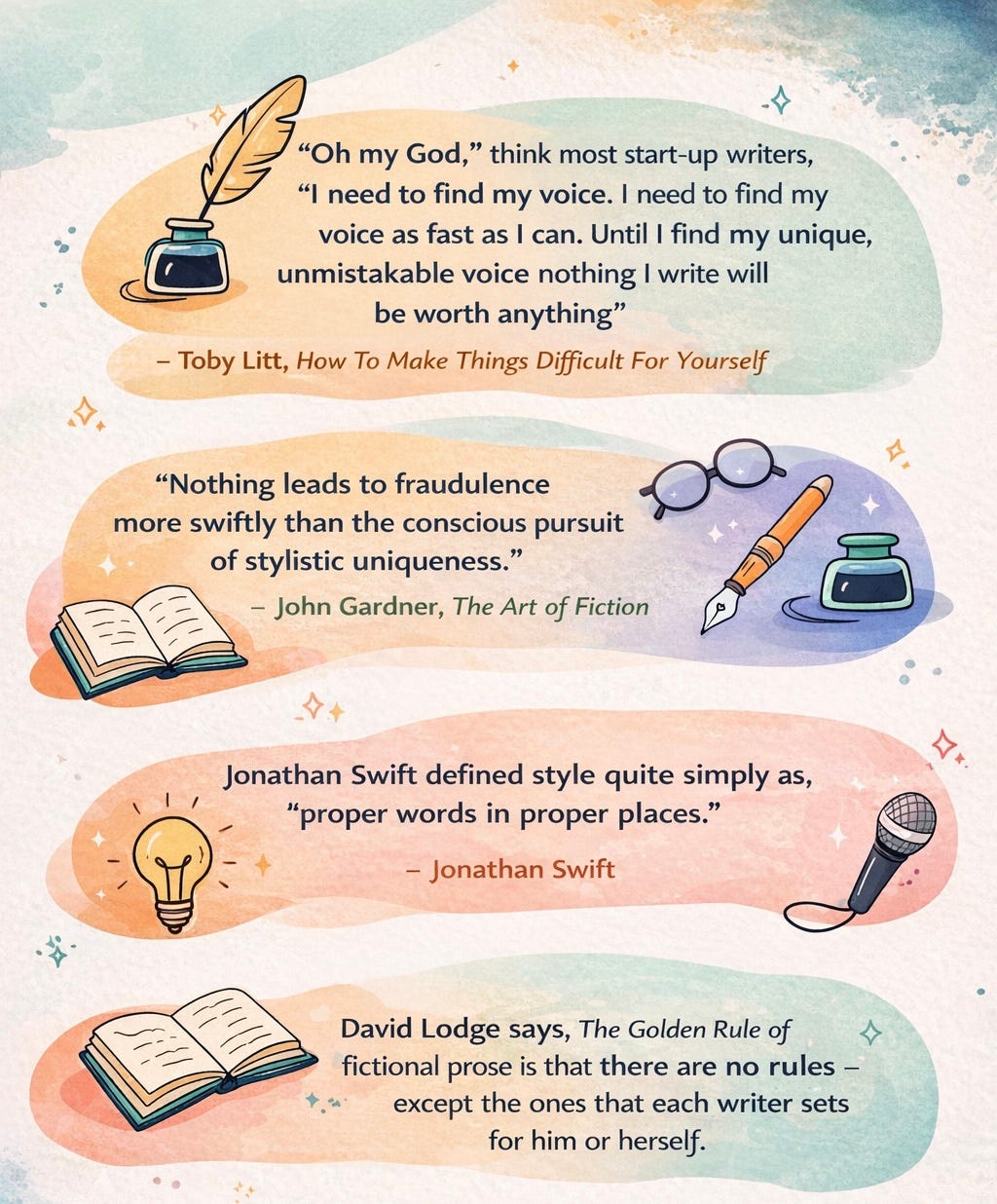
I think as a writer I’ve always wanted to feel like what David Lodge wrote and not think that I’m simply taking the easy way out of learning the foundations of writing. Meanwhile, I think deep inside I’ve always been like Toby Litt, trying really hard to find my voice and concentrating on it too much.
What sparked another interesting conversation in my head was when I voiced these thoughts in class, one of my classmates wrote the following likes in the chat, “I think you have a very good voice based on what I’ve read. Your piece about the light that you posted in “Writing from Life” was brilliant. It gave me several ideas for short stories. I was seriously considering, for my first big assignment where you have to pick a writer you admire and copy them, if I could pick you and do a story based on yours.” I was shocked, really. Not only because I didn’t feel like I had a specific voice, not only because I didn’t think it was good enough, but I also didn’t think it would ever be close to being good and inspiring someone else. Yesterday, during class, he highlighted that he was inspired by my story again and asked me whether he could continue my story. Unbelievable…
These compliments awoke so many thoughts in me. Oftentimes we see ourselves as unworthy and untalented to the point that we fall into a very negative world that doesn’t necessarily have elements of reality in it. Trying to become “the best writer” (whatever that means) we limit our creativity, trying to follow all the rules and conventions, hence putting ourselves in a box that sometimes becomes suffocating and limiting.
Speaking of limiting and putting in a box — in scope of voice, we also talked about characters and how to write from different perspectives. Our instructor was saying that at times it might be helpful to build an emotional CV for our character(s). You can find some of the potential questions you can ask yourself about your character(s).
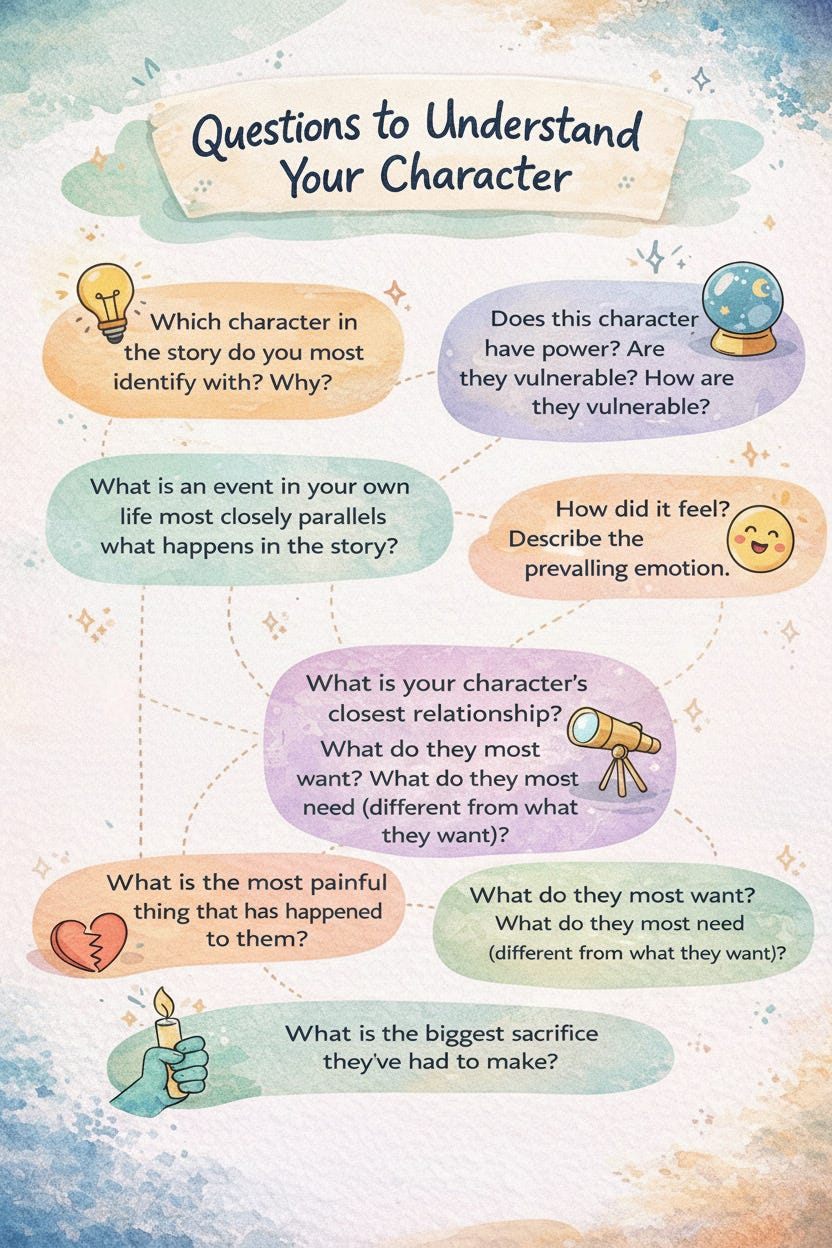
I’ve always had a hate-love relationship with “planning” a character. If I started with an outline, jotting down their strengths, fears, weaknesses and all the other details, I felt like I constantly needed to go back to those “guidelines” to see whether my character still fit them. On the other hand, when I didn’t have anything outlined at all and just went with the flow, it seemed to me that my characters were blending and didn’t have a personality of their own. One of my classmates offered a solution — to have the middle approach and have a simple draft outline for the character. It wouldn’t be something too complicated and multilayered, to the point that it turns into borders for your imagination, but it could become a flexible guiding document that could potentially be modified in the process if needed.
For me the highlight of the week were the assignments that we needed to complete on voice and style. For the forum activity we needed to write a short piece (100-250 words) in the voice of a young child (under 7) or an old person (over 85). By doing that you obviously think about the specific vocabulary, structure, etc.
For the longer assignment we had to write a story from an unusual perspective. These were the perspectives suggested by our instructor.
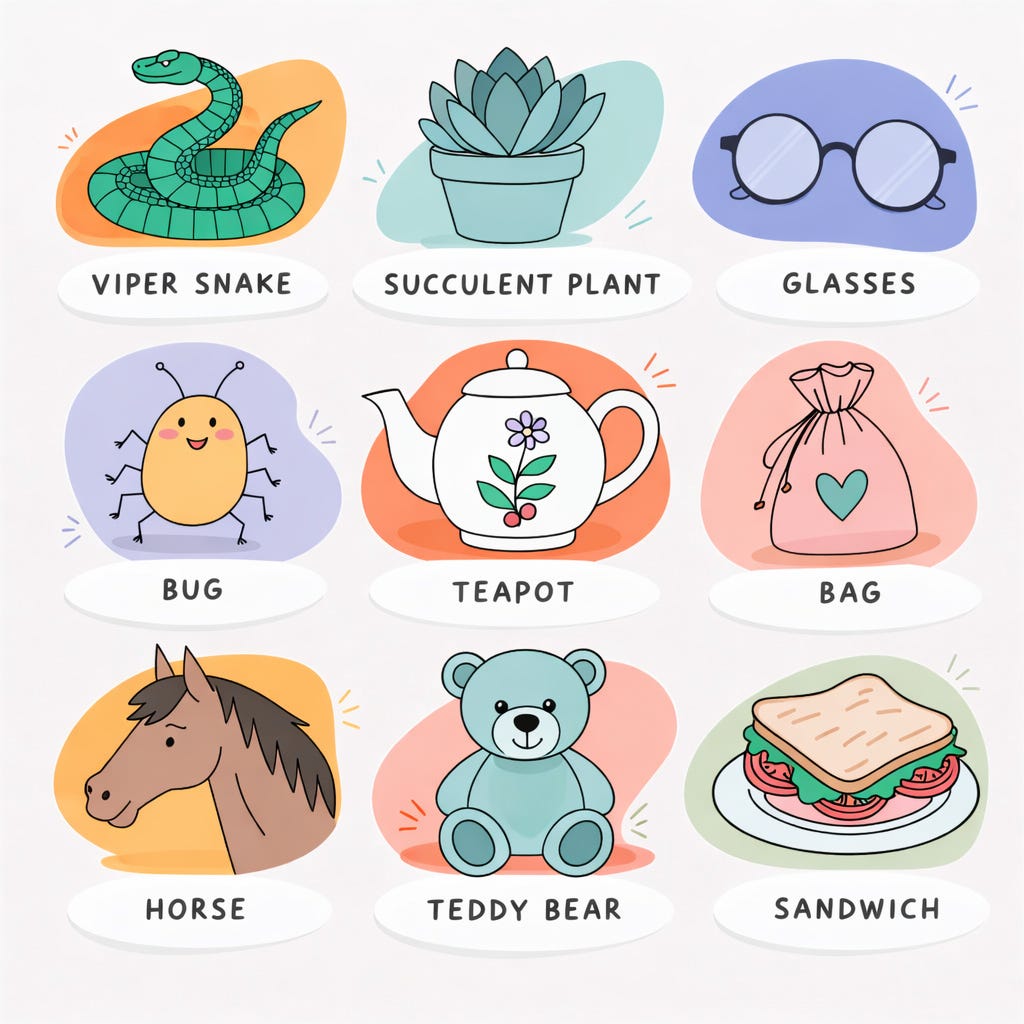
These were some of the potential questions we needed to consider in our minds when writing the story.
Think about the voice and the perspective this object or animal could have.
Is the voice first person or third person, is the perspective limited or omniscient?
Think about what you could do to develop a unique voice or point of view for your narrator.
It was such an interesting assignment for me and I had so much fun writing from the unusual perspective. I had never thought about writing from the perspective of these objects or animals, so I was so happy that I got the chance to try it through this assignment. I had a few choices in mind — the glasses, the teddy bear, and the bag — and eventually I chose the bag. I might share the mini story in my next article.
This was so great! Can’t wait to see you write from the perspective of the bag.
I really like your take on learning your voice. You’re a very intelligent woman and your writing is crisp, easy to “get.” You should know that some successful writers “stand in” for authors who have passed away. They had to adapt to the original author’s voice and write a book in the original author’s name. (I can’t think of the names right now). That says that we have to learn to copy another writer’s voice. Nothing you need to look into now Lora. But I like your voice, very clear and understandable. I’m proud of you!